
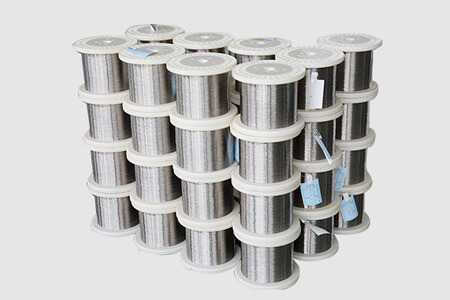
TA1 titanium alloy is a new type of metal, and its properties are related to the impurity content of carbon, nitrogen, hydrogen, oxygen, etc. Pure titanium iodide impurity content does not exceed 0.1%, but its strength is low and its plasticity is high. The performance of 99.5% industrial pure titanium is: density ρ= 4.5g/cm3, melting point at 1800 ℃, thermal conductivity λ= 15.24W/(m.K), tensile strength σ B=539MPa, elongation δ= 25%, reduction of area ψ= 25%, elastic modulus E=1.078 × 10⁵MPa, hardness HB195.
Chemical composition:
| Grade | Main components | ||||||||
| Ti | Al | Mo | Mn | V | Ni | Zr | Si | B | |
| TA1 | Remainder | — | — | — | — | — | 一 | 一 | |
| Impurities (≤) | |||||||||
| Pd | Cr | Fe | C | N | H | 0 | other elements | ||
| single | sum | ||||||||
| 0.20 | 0.08 | 0.03 | 0.015 | 0.18 | 0.10 | 0.40 | |||
Application field:
Mainly used for manufacturing compressor components, such as forged titanium fans, compressor discs and blades, cast titanium compressor casings, intermediate casings, bearing shells, etc. Spacecraft mainly utilize the high specific strength, corrosion resistance, and low-temperature resistance of titanium alloy to manufacture various pressure vessels, fuel storage tanks, fasteners, instrument straps, frames, and rocket shells. Artificial Earth satellites, lunar modules, manned spacecraft, and space shuttles also use titanium alloy plate welding components.
